Edith Holler by Edward Carey Review – An Unsettling Fairytale
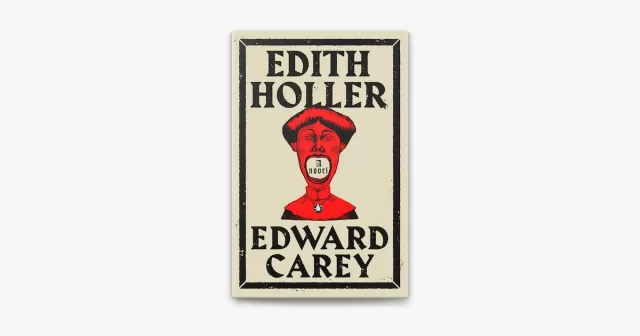
In Edith Holler, Edward Carey weaves an eerie and atmospheric narrative that balances the delicate line between fairy tale and dark fantasy. Set in 1901 Norwich, the novel follows 12-year-old Edith Holler, a girl who has never left the confines of the theater where she lives, for fear of an ancient curse that threatens to bring the building crumbling down if she steps outside. This peculiar and claustrophobic world is where Edith spends her days, surrounded by a troupe of strange, long-embedded theater workers, all of whom seem more like creatures of myth than real people.
The Holler family is a famed theatrical dynasty, and Edith's father is the leading actor, perpetually followed by his eerie understudy, Mr. Collin, who can only be told apart by the faint trace of a putty nose. Edith's life, marked by routine and tragedy, takes a darker turn as she begins to suspect that her father may not be who he seems—a fear that haunts her in this unnervingly off-kilter world. The novel thrives on this tension between humor and horror, capturing moments that are simultaneously unsettling and playful.
At the heart of the novel is the mystery of why Edith is trapped in the theater. While the curse and an exploding relative serve as convenient reasons, these explanations remain vague and improbable, adding a layer of uncertainty that reinforces the fairy-tale quality of the narrative. The public, drawn by Edith's peculiar existence, are invited to witness her in a dumbshow under the sign: "The Holler Theatre, Home of the Child Who May Never Leave."
Told through Edith's own precocious voice, her narration is both haunting and innocent, with a keen sense of observation. She listens to the echoes of her father's tragic Shakespearean performances through the theater's heating pipes, and her understanding of the power of sorrow is striking: "Sorrow is our business," she says, describing the theater's role in providing emotional catharsis to the people of Norwich.
Adding to the novel's distinctive tone are Carey's illustrations, which blend perfectly with the story's odd, Gothic atmosphere. His hauntingly grotesque yet human sketches, reminiscent of Edward Lear and Mervyn Peake, enhance the world of Edith Holler and bring her confined universe to life.
Throughout the story, Edith's imagination runs wild as she unearths secrets about the city outside her theater walls. Convinced that a dark truth involving missing children and a strange local delicacy called Beetle Spread lurks within Norwich's history, she embarks on a quest to reveal it through a play of her own. The novel embraces folkloric elements—Beetle Spread draws inspiration from medieval superstitions about deathwatch beetles, which once threatened timber structures in the region.
In many ways, Edith Holler serves as a love letter to the theater, capturing its strange magic and the way stories seem to take on a life of their own. As Edith reflects, "The stage was a place where millions of words had fallen, tumbling through the floorboard cracks, but after a while some of them worked their way back up again, floating about like mites of dust and remembering themselves a very little."
Carey's novel also extends this affection to Norwich, with its rich tapestry of history and folklore. Local legends, such as King Gurgunt slumbering beneath Norwich Castle, and the ghost of the Grey Lady, populate the novel, infusing it with a sense of place that grounds its fantastical elements.
Written during the pandemic when theaters were closed, Edith Holler carries a deep nostalgia for the theater and its storytelling power. Its mixture of macabre, humor, and gothic whimsy makes it a richly textured and idiosyncratic fairytale, one that invites adults to revisit the strange, unsettling beauty of stories we often leave behind in childhood.